Wikipedia

Search results

Showing posts with label HISTORY OF INDIA. Show all posts

Friday, 10 February 2017

Vedic Period

Vedic Period : The Aryans
 
The Aryans were semi=nomadic people
Entered India probably through the Khyber Pass (Hindukush Mountains) around 1500 BC.
Early Vedic or Rigvedic Period
Political Organisation
Monarchial form. Tribe was known as Jan and its king as Rajan.
Family was the basic unit of society. The family was patriarchal in nature.
» The Samiti was the National Assembly of the people while the Sabha was Council of Elders.
Social n Social structure was patriarchal.
Women had a high place in society and were co-workers and co-partners in the life with their husbands.
» Caste system was not hereditary, but was based on one’s own profession.
Economy ” Aryans followed a mixed economy~pastoral and agriculturalin which cattle played a predominant part.
Standard unit of exchange was cow. At the same time coins were also there.

Script: 

» The script is pictographic, not deciphered. 

End/Decay 

» Invasion of the Aryans, recurrent floods, social breakup of Harappans, earthquakeS, major ecological Changes etc. are listed as possible causes. 
 Religion 
» The Aryans personified the natural forces and looked upon them as living beings. 
» The most important divinity was Indra who played the role of warlord (breaker of forts purandar). 
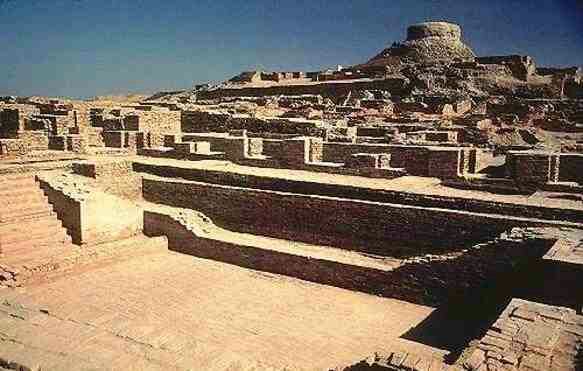
Indus Valley

Indus Valley
 
1. Indus Civilisation is one of the four earlieSt civilisation of the world along with the civilisation of Mesopotamia (Tigris and Eugphrates), Egypt (Nile) and China (Hwang Ho).
2 The civilisation forms part of the proto-history of india and belongs to the Bronze age.
3.The most accepted period is 2500-1700 BC (by Carbon-14 dating)
4.Dayaram Sahni first discovered Harappa in 1921.
RD Bannerjee discovered Mohenjodaro in 1922.
Geographical Extent
Covered parts of Punjab, Sindh, Baluchistan, Gujarat, Rajasthan and some parts of Western UP.
Major sites in Pakistan are Harappa (on Ravi in Western Punjab), Mohenjodaro (on Indus), Chanhu-Daro (Sindh), etc. In India, major sites are Lothal, Rangpur and Surkotda (Gujarat), Kalibangan
(Rajasthan), Banwani (Hissar), and Alamgirpur (Western UP
Town Planning


Town- Planing
Elaborate town-planning. It follows the grid system. Roads well out, dividing the town into large rectangular blocks.
Used burnt bricks of good quality. It Good drainage system.
In Mohenjodaro, a big public bath (Great Bath) measuring 12 m by 7 m and 2.4 m deep, has been found. 

Agriculture
 
» Grew wheat, barley, rai, peas, sesamum, mustard, rice
(in Lothal), cotton (first to produce cotton), dates, melon, etc.
Used wooden ploughs.
Art: and Graft;
The Harappan Culture belongs to the Bronze Age. in Potter’s wheel was in use.
Bronze image of the famous dancing girl (identified as devadasi) has been found at Mohenjodaro. Economic Life
» Barter system was there. 16 was the unit of measurement.
an seals (made of steatite, had design on one side)  and other material has been found at Mesopotamia. 

Religious Life . 

main object of worship was the Mother Goddess.
phallus (lingam) and yoni worship was also prevalent. 
Many trees (pipal), animals (bull), birds (dove, pigeon)  and stones were worshipped, 

Thursday, 9 February 2017

Ancient India

The Stone Age : Pre History

1: The fossils of the early human being have not beet found in india, but in Africa about 2.6 million years back. So, it appears that lndia was settled later than Africa.
2. The recent reported artefacis from Bart in Maharashtra suggest the appearance of human beings in india around 1.4 million years ago. 


3. The early man in india used tools of stone roughly dressed by crude clipping. This period is therefore. known as the StoncAge, which has been divided into “the Palaeolithic or Old Stone Age (5 lakh 9000 BC) The Mesolithic or Middle Stone Age (9000-4000 BC) ' The Neolithic or New Stone Age (4000-1000 BC)
4. it seems that Palaeolithic men belonged to the Negnto race. Homo sapiens first appeared in the last of this phase.
5.Palaeolithic men were hunters and food gatherers. They had no knowledge of agriculture. lire or pottery. they used tools of unpolished, undressed rough stones and lrved in cave rock shelters They are also called Quartzite men
6. The mesolithic people lived on hunting. fishing and food-gathering. At a later stage they also domesticated animals.
7. The characteristics tools of the Mesolithic Age are microliths, pointed cresconic blades. scrapers, etc, made up of stones.
8. Mamgari: in Madhya Pradesh and Bagor in Rajasthan pmvrde the earliest evrdence for the domestication of animals.
8.The people of Palaeolithic and Mesolithic ages practictsed painting, Bhimbctkn in Madhya Pradesh is a striking site of Pre-historic painting.
9.The people of Neolithic age used tools and implements of polished stone. They particularly used stone axes.
10.it is interesting that in Bumhom domestic dogs were buried With their masters in their graves.
The neoliihic settleis were the earliest farming communities. They produced ragi and horse-gram (kulaihi). Neolithic Sites in Allahabad district are noted for the cultivation of rice in the SlKll’i millenium BC. They domesticated cattle. sheeps and goats. They wove cotton and wool to make cloths.
11.Hand made pottery and use ot‘ potter wheel first appears during the neolithic age.